
Main article: Free combat
In free combat monsters show their attacks before they land. A monster about to attack glows in the colour of its attack style, and big attacks mark the ground where they will hit. That warning is called a tell: read it, then step out of the way, roll through it, or pray against it.
Every player fights monsters this way, everywhere free combat works. Bosses go further, with move sets of their own: see Bosses.
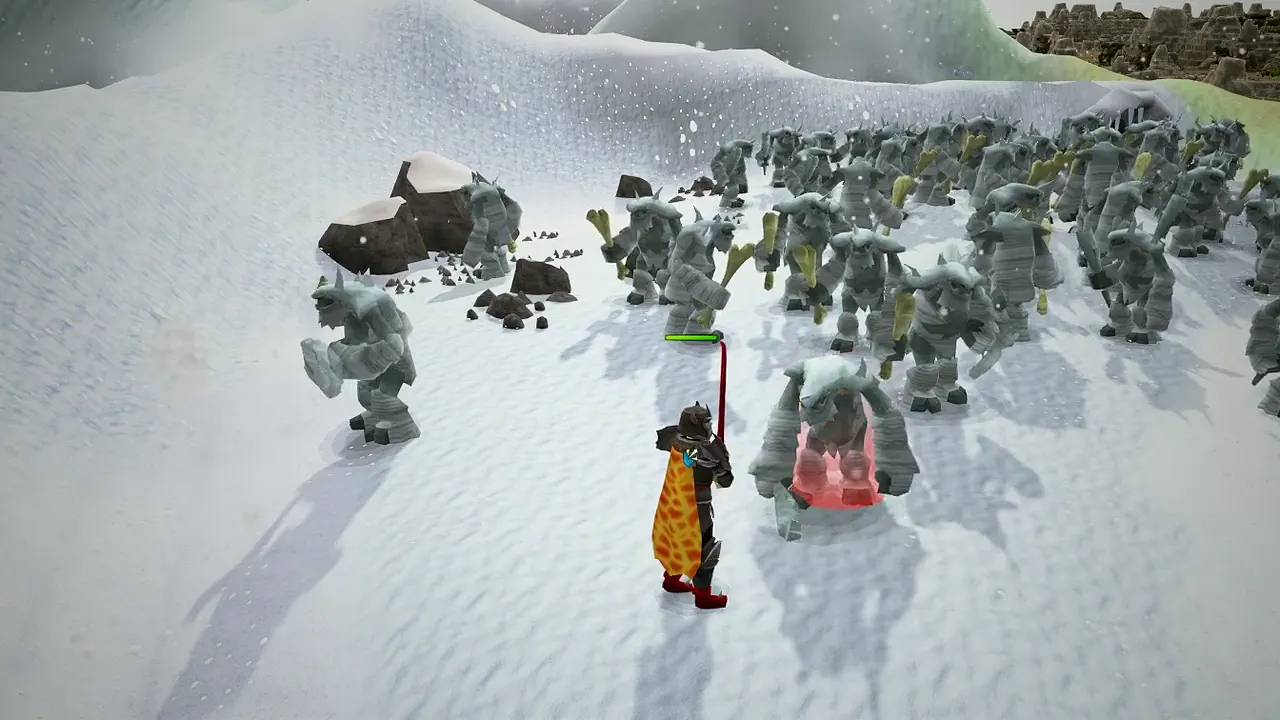
Reading a tell
- The glow shows the style. Red is a melee attack, green a ranged attack, blue a magic attack. Dragonfire, poison, ice and the bosses' own attacks have colours of their own.
- Ground marks show where it lands. Circles, lines, cones and stomps mark the area an attack will cover. Get out of the mark before it lands.
- Bigger attacks warn you longer. Every tell gives you at least this long:
| Kind of attack | Warning at least |
|---|---|
| A quick nip | 0.35 s |
| A light attack | 0.45 s |
| A heavy attack | 0.7 s |
| An attack on an area | 0.9 s |
| A monster's signature move | 1.4 s |
| From behind you | 0.15 s more |
- A heavy hit staggers you. A heavy move, or any hit for 15% or more of your life points, staggers you for a moment. New players are spared: low-level humanoid monsters (level 20 or below) never stagger a player of combat level 30 or below. See Staggers.
What to do
- Step out. For anything that marks the ground, walking or running out of the mark is the safest answer.
- Roll through. A Dodge roll gives you a short moment, at most 0.6 seconds, when attacks pass through you. Time it for the moment the attack lands. A few attacks can't be rolled through; step out of those.
- Pray. A protection prayer blocks a regular attack of its style, as it did in RuneScape. Breath attacks and monsters' special moves are only halved by it, so dodge those too.
- Keep your distance or close in. Archers and casters try to keep you at range; melee monsters try to stay next to you.
Monster families
Every monster belongs to one of twelve families, and each family fights in its own way:
| Family | How it fights |
|---|---|
| Swarms | Weak monsters that circle you and call up to 4 friends within 5 tiles. Rats, spiders and goblins sometimes run away when they are nearly dead. |
| Passive creatures | Never start a fight. Animals run away when you hit them. |
| Beasts | Circle and flank you. Wolves, dogs and jackals call their pack within 6 tiles. |
| Armed fighters | Chain up to 3 attacks and sometimes hold a block. Guards call other guards within 6 tiles. |
| Unarmed fighters | Step from side to side and chain up to 2 attacks. |
| Large brutes | Pace in front of you and turn slowly. Once a brute is halfway through its tell, hitting it won't stop the attack. |
| Large beasts | Big monsters that shove you out of the space they stand on. |
| Archers | Keep 4 to 7 tiles away, step back if you come within 3, and aim a little ahead of you when you move. |
| Casters | Keep 5 to 8 tiles away. |
| Dragons | Breathe fire and turn slowly. |
| Mixed fighters | Switch between attack styles. |
| Turrets | Never move. |
Staggering monsters
Monsters can be staggered too. Hit a monster for enough of its life within a few seconds and it breaks off what it is doing.
| Family | Damage that staggers it |
|---|---|
| Beasts, unarmed fighters, archers, casters | 10% of its life within 3 seconds |
| Armed fighters, mixed fighters | 15% within 3 seconds |
| Large brutes, large beasts | 25% within 5 seconds |
| Dragons | 35% within 5 seconds |
| Turrets | 100% within 5 seconds (in practice, never) |
| Swarms, passive creatures | Never |
- Bigger monsters need more: a quarter more for every tile of size beyond the first.
- The count starts over if you don't hit the monster for 1.5 seconds.
Things to know
- Monsters go home. A monster pulled too far from where it lives walks back, and heals once no one has hurt it for 10 seconds.
- A few monsters fight as they did in 2012, where their fight is scripted in a special way. Bosses have their own move sets: see Bosses.
- Fighting in groups and single-way areas are on Free combat.
See also
What links here (37)
- Attacking and combos
- Barrows brothers
- Bork
- Boss instances
- Boss pets
- Bosses
- Chaos Elemental
- Commander Zilyana
- Corporeal Beast
- Dagannoth Kings
- Damage and attack speed
- Defence
- Dodge roll
- Drop tables
- Eating, potions and staggers
- Free combat
- General Graardor
- Giant Mole
- Glacor
- Glossary
- K'ril Tsutsaroth
- Kalphite Queen
- King Black Dragon
- Kree'arra
- Lock-on
- Magic in free combat
- Nex
- Parties
- PvP
- Queen Black Dragon
- Ranged in free combat
- Runes and ammo
- Special attacks
- Stamina
- Tormented demons
- TzTok-Jad
- Where to start